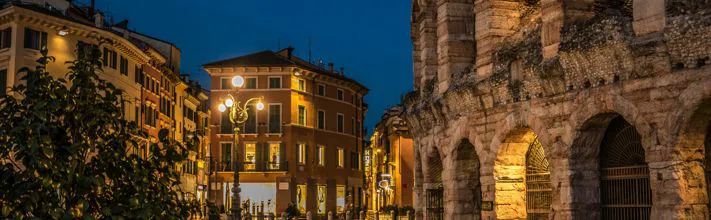
The Verona that buses don’t see. But the van does. Whilst 50-seater coaches jostle for parking spaces outside the city centre, you’ll already be inside — in the narrow alleyways, along the quiet embankments, in the spots where the stone tells a story spanning two thousand years, without signs or crowds. The Olivago van picks you up directly from your hotel on Lake Garda and takes you on a tour lasting around 3 hours, visiting seven stops chosen for what they offer the eye, not just for what appears in the guidebooks.
The itinerary:
- It begins high up, with a breath of fresh air. Castel San Pietro is Verona’s most beautiful balcony: the red rooftops, the bend in the Adige, the Roman Theatre and the whole city spread out below you. The first photo of the tour is worth the trip alone.
- We head down towards the river and arrive at Ponte Pietra — Verona’s oldest Roman bridge, rebuilt stone by stone using materials recovered from the bed of the Adige after the war. The van stops on the riverbank: perfect view, no crowds.
- You enter the historic heart: Piazza delle Erbe, the Roman forum that still bustles like a medieval market, amidst colourful stalls, frescoed palaces and the Madonna Verona fountain. A brief stop, eyes wide open, perhaps a coffee. Then comes the stop that no city sightseeing tour can offer.
- Via Sottoriva: the long medieval portico running parallel to the river, narrow, quiet, with the marks of the 1882 flood still etched on the walls. The vò — the side alleys in the Veronese dialect — descend towards the water like stone gut. The van passes through. The buses don’t. That’s the point.
- Heading back westwards, we pass Porta Borsari and Ponte della Vittoria: the gateway to Roman Verona of the 1st century AD, with Latin inscriptions still legible on the lintel, and the 20th-century bridge with its four equestrian statues overlooking the Adige. Two eras fifty metres apart.
- The finale is cinematic: Arco dei Gavi — the Roman triumphal arch from the 1st century AD, rebuilt stone by stone in the 20th century following its demolition under Napoleon — and then Castelvecchio, the Scaliger fortress on the river with its crenellated bridge.
- The tour concludes with an aperitif featuring spritz and canapés
ITINERARIO
- Si apre in alto, con il respiro. Castel San Pietro è il balcone più bello di Verona: i tetti rossi, l'ansa dell'Adige, il Teatro Romano e tutta la città distesa sotto di voi. La prima foto del tour vale già il viaggio.
Si scende verso il fiume e si arriva a Ponte Pietra — il ponte romano più antico di Verona, ricostruito pietra per pietra con i materiali recuperati dal fondo dell'Adige dopo la guerra. Il van si ferma sul lungadige: inquadratura perfetta, nessuna ressa.
Si entra nel cuore antico: Piazza delle Erbe, il foro romano che batte ancora come un mercato medievale, tra bancarelle colorate, palazzi affrescati e la fontana della Madonna Verona. Breve stallo, occhi aperti, eventuale caffè. Poi arriva la tappa che nessun city sightseeing può fare.
Via Sottoriva: il lungo porticato medievale che corre parallelo al fiume, stretto, silenzioso, con i segni dell'alluvione del 1882 ancora impressi sui muri. I vò — i vicoletti laterali in dialetto veronese — scendono verso l'acqua come budelli di pietra. Il van ci passa. I bus no. Questo è il punto.
Risalendo verso ovest, si transita davanti a Porta Borsari e Ponte della Vittoria: la porta d'ingresso alla Verona romana del I sec. d.C., con le iscrizioni latine ancora leggibili sull'architrave, e il ponte novecentesco con le quattro statue equestri affacciate sull'Adige. Due epoche a cinquanta metri di distanza.
Il finale è cinematografico: Arco dei Gavi — l'arco trionfale romano del I sec. d.C., rimontato pietra per pietra nel Novecento dopo la demolizione napoleonica — e poi Castelvecchio, la fortezza scaligera sul fiume con il suo ponte merlato. Ultime foto, luce perfetta, e si vola verso il Lago.
Aperitivo con spritz e stuzzichini
MAPPA
Esplora il percorso del tour sulla mappa sottostante e scopri tutti i punti di interesse.

 DE
DE IT
IT EN
EN